Odyssey Therapeutics priced an upsized IPO at the top of its range on May 7, 2026 — 15,500,000 shares at $18.00 for $279.0 million gross, plus a $25.0M concurrent private placement — and then broke on debut, closing its first session at $16.42, down 8.8%. As of the September 4 close the stock trades at $28.76, +59.8% versus offer.
TL;DR — Odyssey (Nasdaq: ODTX) is the class’s second-attempt story: it filed an S-1 in January 2025, withdrew it in June 2025, and came back eleven months later with Phase 2a proof-of-concept data in hand for its oral RIPK2 inhibitor in ulcerative colitis. The deal upsized ~17% and priced at the top of range, but the market still made it prove itself — the stock traded mostly below offer (with June and late-July stretches above it) before the Q1 and Q2 prints re-rated it. Roughly $105M of insider buying in and around the deal is confirmed by post-IPO 13D/13G filings, and the greenshoe was only partially exercised (600,000 of 2,325,000 shares per the Q2 10-Q), putting final combined gross near $314.8M — above the ~$304M the pricing release headlined. Cash and investments of $433.1M at June 30 fund operations into H2 2028. Performance figures are marked to the September 4 close; prices move daily. Caveat: the registrational-path trials guided to start in H2 2026 were not yet posted on ClinicalTrials.gov as of September 5.
This is a per-company companion to our 2026 IPO class deep-dive, which found the aftermarket rewarding late-stage single-asset stories and punishing platform narratives. Odyssey refines the finding: the asset here is earlier (Phase 2a, not pivotal), and the tape withheld the premium until public-company prints re-verified the story.
The asset: an oral RIPK2 inhibitor with Phase 2a PoC, and a founder with two prior exits
OD-001 (internal code OD-07656) is an oral small-molecule RIPK2 scaffolding inhibitor in ulcerative colitis, and it is effectively the whole valuation. The Phase 2a proof-of-concept dataset priced the deal: across 49 evaluable patients at week 12, the study showed 27% clinical remission, 33% endoscopic improvement, 47% symptomatic remission, 61% clinical response, and 22% histologic-endoscopic mucosal improvement, against a historic placebo remission benchmark of roughly 10% cited in the prospectus. Two sourcing notes on that trial, NCT06850727: the registry lists an estimated enrollment of 57 — the 49-patient evaluable count is the company’s reported actual — and the study remains marked “recruiting” with an estimated completion of November 2026. The earlier Phase 1 in healthy participants (NCT06206811, 101 enrolled, completed November 2024) underpins the safety file.
The registrational path is now the schedule to watch. Per the 424B4 and the Q2 release (an 8-K exhibit dated August 4; the 10-Q itself was filed August 6), Odyssey plans to initiate both a Phase 2a combination trial of OD-001 plus vedolizumab and a randomized placebo-controlled Phase 2b monotherapy trial in H2 2026, with topline 12-week induction data from both expected in H2 2027. The full Phase 2a induction dataset gets an oral presentation at UEGW in October 2026. As of September 5, neither guided trial had appeared on ClinicalTrials.gov — the registry is the first place a slip would show.
Behind OD-001: OD-002, an oral SLC15A4 inhibitor (TLR7/8/9 pathway) aimed at SLE and interferonopathies, IND-enabling at pricing with a CTA filing planned by end of 2026 and Phase 1/2a healthy-participant data expected H2 2027; and OD-003, a selective TNFR2-agonist protein therapeutic, the most advanced wholly owned preclinical program. A September 2024 Terray Therapeutics collaboration on IRF5 runs at a 50/50 profit/loss split with no upfront payment. The company stresses internal discovery — “a portfolio of completely internally discovered and developed medicines” — though it did acquire IFM Discovery (2022) and Rahko (2021) with milestone-based contingent consideration.
Founder-CEO Gary Glick is the other half of the story: he previously founded IFM Therapeutics ($750M in proceeds from three program sales, with over $4.7B in contingent consideration) and Scorpion, sold to Lilly in 2025 for up to $2.5B. Director Jeffrey Leiden is the former Vertex CEO. Odyssey raised ~$726.5M privately since its April 2021 incorporation from more than 30 investors, including a ~$213.6M Series D that closed between June and October 2025 at $1.50497 per share. The pre-IPO register was crossover-heavy: SR One (10.6%), OrbiMed (9.0%), FMR (8.3%), Jeito (7.6%), TPG (7.6%), Lightspeed (7.3%), and Dimension (7.3%) all held above 5%.
The deal: upsized at the top of range, partial shoe, and $105M of confirmed insider money
| Step | Shares | Price | Gross |
|---|---|---|---|
| Marketed range (S-1/A, May 4) | 13,240,000 | $16–18 | $212–238M |
| Priced (May 7) — top of range, upsized ~17% | 15,500,000 | $18.00 | $279.0M |
| Concurrent private placement to TPG affiliate (closed May 11) | 1,388,889 | $18.00 | $25.0M |
| Greenshoe — partially exercised (600,000 of 2,325,000) | 17,488,889 issued in total | $18.00 | +$10.8M → ≈$314.8M combined |
Table 1: Odyssey pricing steps per the S-1/A, the pricing release, the placement 8-K, and the Q2 2026 10-Q equity statement. Net proceeds are prospectus estimates: $255.4M from the IPO ($294.3M had the shoe been exercised in full) plus ~$23.3M from the placement.
Two corrections to the headline record. First, the ~$304M “combined gross” in the pricing release predates the greenshoe outcome; the 10-Q shows the underwriters took only 600,000 of the 2,325,000 option shares, so final combined gross is ≈$314.8M. Second, this was not a debut — Odyssey filed its first S-1 on January 17, 2025 and withdrew it by Rule 477 letter dated June 9, 2025, a pull Fierce Biotech read as a sign of the then-hostile window. The 2026 repricing came back with Phase 2a data and a Series D that had closed at $1.50 per share between June and October 2025.
The syndicate ran J.P. Morgan (6.2M shares), TD Cowen (4.65M), and Cantor Fitzgerald (3.1M) as joint book-runners, with Wedbush and Oppenheimer as co-leads. Unlike the class names that priced without disclosed cornerstones — Hemab, for one — Odyssey’s insider participation is documented after the fact: 13D/13G filings confirm Dimension Capital bought 1,111,111 shares ($20.0M) in the IPO, Jeito II bought 1,388,888 ($25.0M), SR One bought 555,555 ($10.0M), and Lightspeed’s post-deal position implies roughly 1,388,888 shares (~$25M) added — about $105M of insider money including TPG’s $25M placement, better than a third of the IPO tranche. At $279.0M, the base deal is 0.9x the class median of $294.8M; the ≈$314.8M final combined figure is 1.1x.
The tape: months mostly underwater, then two prints and a quiet September leg
ODTX closed its debut at $16.42 (−8.8% vs the $18.00 offer on May 8) and spent much of the summer below water (above offer for stretches in mid-June and late July), marking its lowest close at $15.56 on July 8 (−13.6% vs offer). The re-rates are dated and tied to prints, not clinical news: the Q1 release (8-K exhibit dated June 17) carried the close from $17.87 to $19.07 (+6.7% over two sessions), and the Q2 print on August 4 took it from $18.13 to $19.96 (+10.1%) and then $21.55 by August 6 (+18.9% over three sessions). The final leg — $24.36 on August 28 to $28.76 on September 4, +18.1% in five sessions — has no corresponding 8-K; the nearest disclosed item is an August 26 investor-conference participation notice. No clinical-data or management-change 8-K has been filed since the IPO.
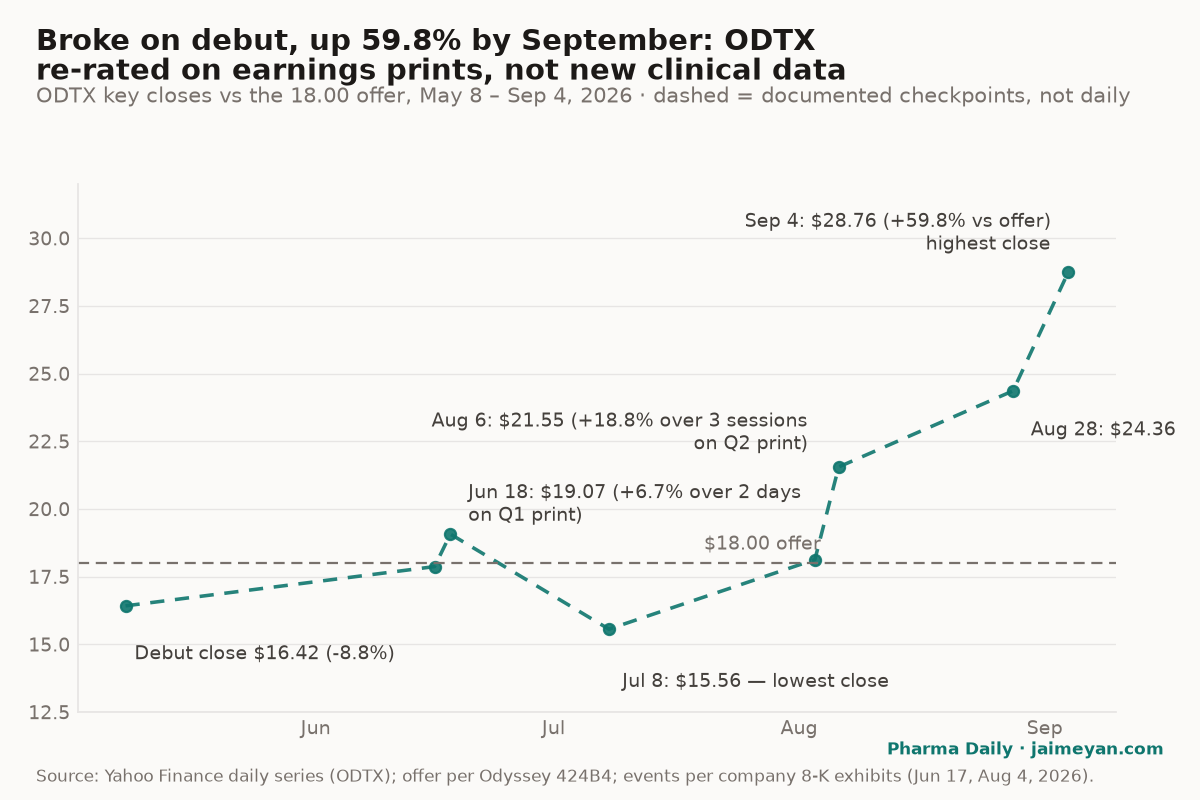
Figure 1: ODTX’s recovery came in three steps — two earnings prints and an unattributed September leg — after months mostly below the offer price. Documented closes per the Yahoo Finance daily series; dashed segments connect documented checkpoints, not a daily series. “Highest/lowest” refer to closing prices.
Against the class bifurcation: Odyssey is a single-lead-asset company with data in hand, and the tape eventually paid for exactly that — but only eventually. The −8.8% debut on an upsized, top-of-range deal says the market discounted the story at pricing, the way it discounted the platform narratives of Eikon and Generate outright. What separated Odyssey is that the discount was temporary: each public print re-verified the Phase 2a dataset and the runway, and the register’s $105M of confirmed insider buying gave the deal a floor those platform names lacked.
What would change the story
- UEGW, October 2026 — the oral presentation of the full Phase 2a induction dataset is the first independent look past the 49-patient summary in the prospectus.
- Trial initiations, H2 2026 — the Phase 2b monotherapy and Phase 2a vedolizumab-combination trials are guided to start this half; neither is on ClinicalTrials.gov as of September 5, so the registry is the tell.
- Topline induction data, H2 2027 — the 12-week readouts from both trials are the make-or-break for the registrational path and consume the bulk of the ~$135M of proceeds earmarked for OD-001.
- OD-002 CTA by end of 2026 — the SLC15A4 program (~$50M earmarked) is the first test of whether Odyssey is a one-asset company.
- Financing vs runway — cash and investments of $433.1M at June 30 are guided to last into H2 2028; a raise before the H2 2027 readouts would contradict that guidance.
One Take
Odyssey refines the class bifurcation finding rather than confirming it outright: the tape did reward a single-asset story with PoC data in hand, but it made the company earn the premium twice — once at pricing (which it failed, closing down 8.8%) and once through two quarterly prints (which it passed, re-rating +59.8% by September 4). Glick’s framing of the raise as building a “little large pharma” is a platform narrative, and there is no evidence the market paid for it; what it paid for is a dated, fully funded path to two H2 2027 induction readouts, plus $105M of insider money it could verify in 13D/13G filings. Conviction: moderate that ODTX trades on trial-registration and UEGW mechanics through year-end, because nothing else is scheduled. Falsifiers: the Phase 2b or combination trial failing to appear on ClinicalTrials.gov by year-end, a UEGW dataset that diverges from the prospectus summary, or any financing before the H2 2027 readouts despite the stated H2 2028 runway.
Key takeaways
- Odyssey priced 15.5M shares at the $18.00 top of range on May 7 (upsized ~17%) for $279.0M gross, plus a $25.0M concurrent placement to a TPG affiliate; the greenshoe was only partially exercised (600,000 of 2,325,000 shares), putting final combined gross at ≈$314.8M — above the ~$304M headline.
- The base deal is 0.9x the class median raise of $294.8M; including the placement and partial shoe it is 1.1x.
- Post-IPO 13D/13G filings confirm ~$105M of insider buying in and around the deal (Dimension $20M, Jeito $25M, SR One $10M, Lightspeed ~$25M implied, TPG $25M placement).
- The tape: −8.8% debut close (May 8), lowest close $15.56 (July 8), then re-rates on the Q1 print (+6.7% over two sessions in June) and Q2 print (+18.9% over three sessions in August) to a highest close of $28.76 on September 4, +59.8% vs offer.
- This was a second attempt: Odyssey withdrew a prior S-1 in June 2025 and returned with Phase 2a PoC data — 27% clinical remission at week 12 in 49 evaluable UC patients — and a runway into H2 2028 that funds both guided H2 2027 readouts.
FAQ
Why did Odyssey break on debut if the deal was upsized at the top of range?
Upsizing and top-of-range pricing measure book demand during marketing; they do not guarantee aftermarket support. ODTX closed its first session at $16.42, down 8.8%, and stayed below the offer price until the June Q1 print — consistent with a market that wanted the Phase 2a story re-verified as a public company before paying for it.
Is the $304M headline the final raise?
No. The pricing release headlined ~$304M of combined gross before the greenshoe outcome. The Q2 10-Q shows only 600,000 of the 2,325,000 greenshoe shares were exercised, so final combined gross is ≈$314.8M ($279.0M IPO + $25.0M placement + $10.8M partial shoe). Net proceeds are disclosed only as prospectus estimates: ~$255.4M from the IPO plus ~$23.3M from the placement.
What is the next ODTX catalyst?
The full Phase 2a induction dataset as an oral presentation at UEGW in October 2026, then the guided H2 2026 initiations of the Phase 2b monotherapy and Phase 2a vedolizumab-combination trials — neither yet posted on ClinicalTrials.gov as of September 5. Topline 12-week induction data from both are expected H2 2027.
Sources
First-hand (filings, releases, registry):
- Odyssey Announces Pricing of Upsized IPO (15.5M shares at $18.00) — GlobeNewswire, 2026-05-08
- Odyssey 424B4 final prospectus (pipeline, Phase 2a data, use of proceeds, underwriting, principal stockholders) — SEC EDGAR
- Odyssey S-1/A, May 4, 2026 (13.24M shares at $16–18) — SEC EDGAR
- 8-K, May 11, 2026 (TPG $25M concurrent private placement) — SEC EDGAR
- Q2 2026 10-Q (cash and investments $433.1M at June 30; partial greenshoe exercise; 48,058,527 shares outstanding at August 3) — SEC EDGAR
- Q1 2026 results 8-K exhibit, June 17, 2026 and Q2 2026 results 8-K exhibit, August 4, 2026 — SEC EDGAR
- Rule 477 withdrawal letter, June 9, 2025 (prior S-1 filed January 17, 2025) — SEC EDGAR
- Post-IPO ownership: Dimension Capital 13D · Jeito II 13D · SR One 13D · Lightspeed 13G · FMR 13G · TPG 13D — SEC EDGAR
- ClinicalTrials.gov: NCT06850727 (OD-07656 Phase 2a in UC; registry enrollment of 57 is the estimate) · NCT06206811 (Phase 1, completed) · sponsor query
Aftermarket and context:
- The New Biotech IPO Class: Bigger, Later-Stage, and Judged Harder — Pharma Daily (parent analysis; class table and median)
- Odyssey CEO sees $304M IPO creating ‘little large pharma’ — Fierce Biotech, 2026-05-08
- Odyssey abandons IPO plans in latest sign of tough environment for biotech listings — Fierce Biotech, 2025-06-10
- Odyssey investor-conference participation notice, August 26, 2026 — company IR
Provenance: collected 2026-09-05. Filing figures from the EDGAR documents above; prices (debut close $16.42; Jun 16 $17.87 → Jun 18 $19.07; Jul 8 $15.56; Aug 3 $18.13 → Aug 6 $21.55; Aug 28 $24.36; Sep 4 $28.76) via the Yahoo Finance daily series for ODTX. Percentages vs the $18.00 offer are computed from those closes; “highest/lowest close” refer to closing prices, not intraday extremes. Event dates above are the dates of the underlying releases; the Q2 10-Q itself was filed August 6, 2026. Insider purchase amounts are as stated in the linked 13D/13G filings; Lightspeed’s IPO purchase is implied from pre- and post-deal positions, not separately stated. All performance figures are marked to the September 4, 2026 close and will move with the market.