Braveheart Bio priced its IPO above range on August 5, 2026 — 21,250,000 shares at $18.00 against a $15–17 marketed range, upsized from 18.75 million — for $382.5 million gross, and $439.9M after the greenshoe was exercised in full at the August 7 closing. One month in, the stock holds the pop: $26.74 as of the September 4 close, +48.6% versus offer.
TL;DR — Braveheart (Nasdaq: BRVE — the class table left the ticker unverified; confirmed here from the 424B4) is a single-asset NewCo built by Forbion and OrbiMed around BHB-1893, a cardiac myosin inhibitor in-licensed from Jiangsu Hengrui in September 2025 for $32.5M cash plus 32.5M shares. It is the class’s second Hengrui-fed IPO after Kailera — and the tape is treating them oppositely (+48.6% vs +1.4%, both as of September 4). Performance figures are marked to that close; prices move daily. Caveat: the nearest proof point is not Braveheart’s own — Hengrui’s China Phase 3 in obstructive HCM has a primary completion estimated this month, and Braveheart’s own global Phase 3 only starts in 2H 2026.
This is a per-company companion to our 2026 IPO class deep-dive, which tracked the China-asset in-licensing flow into the 2026 IPO window. Braveheart is the cleanest single-variable test of whether that flow carries a tape discount.
The asset: BHB-1893, one molecule, a proven class, and a licensor reading out this month
BHB-1893 (Hengrui’s HRS-1893) is Braveheart’s only pipeline asset: an oral, highly selective cardiac myosin ATPase inhibitor for hypertrophic cardiomyopathy, positioned as a next-generation entrant behind mavacamten (Camzyos) and aficamten (Myqorzo) — a class with an established market, which distinguishes it from most first-in-class IPO stories.
The data package is Hengrui-generated but close to decision-grade. In the China Phase 2 in obstructive HCM, the cohort starting at 40 mg twice daily (titrated up to 80 mg) showed an 86% complete response (post-Valsalva LVOT gradient below 30 mmHg) at Week 12, mean gradient below threshold by Day 5, and — the number the CMI class lives and dies on — no patient with LVEF below 50% in the 12-week core period; the open-label extension held 86% below threshold at Week 28 across all 42 patients, with two transient LVEF <50% events in the extension that resolved after dose reduction, as the 424B4 discloses. A randomized placebo-controlled Phase 2 in non-obstructive HCM read out positive in May 2026. Over 300 individuals have been dosed globally as of June 9, 2026.
The trial map splits by licensor and licensee. Hengrui’s China Phase 3 in oHCM (NCT07021976, 228 patients, active-not-recruiting) lists a primary completion of September 2026 — essentially now. Braveheart’s own program: LIONHEART-HCM, a global Phase 3 in obstructive HCM testing BHB-1893 head-to-head against metoprolol (NCT07755904, 210 patients, not yet recruiting; starting 2H 2026 with an interim topline guided for 2H 2027 and primary completion estimated October 2028), and NOBLEHEART-HCM in non-obstructive HCM starting 1H 2027.
The company is a purpose-built NewCo: incorporated May 2024, operations began 2025, assembled by Forbion and OrbiMed around the Hengrui asset. CEO Travis Murdoch founded HI-Bio (sold to Biogen in 2024 for up to $1.8B); the CFO is ex-Alpine Immune; a16z’s Vineeta Agarwala joined the board at closing. Pre-IPO holders: Forbion 27.8%, OrbiMed 15.6%, a16z 13.9%, Hengrui itself 11.3% (non-voting), Frazier 5.2%. Private capital in: roughly $185M.
The deal: above range, Fidelity in the book, and a cheap license underneath
| Step | Shares | Price | Gross |
|---|---|---|---|
| Marketed range (S-1/A, Jul 30) | 18,750,000 | $15–17 | $281–319M |
| Priced (Aug 5) — above range, upsized | 21,250,000 | $18.00 | $382.5M |
| Greenshoe exercised in full (closed Aug 7) | 24,437,500 | $18.00 | $439.9M |
Table 1: Braveheart pricing steps per the 424B4, Renaissance Capital, and the closing release / Goodwin deal announcement.
Fidelity held a non-binding anchor indication of up to $75M (~20% of the deal); whether it converted to an actual allocation is not disclosed post-IPO. The syndicate: Goldman Sachs, Jefferies, TD Cowen, Stifel, Cantor. At $382.5M the deal is 1.3x the class median, at a fully diluted value of roughly $1.6B at pricing.
The license economics deserve their own paragraph, because they are the bull case. Per the 424B4, Hengrui received $32.5M cash upfront plus 32,500,000 non-voting Series A shares at $1.00 (fair value $25.7M; Hengrui’s own release frames the upfront as $65M cash-plus-equity), up to $23M of tech-transfer and development milestones ($9.0M already incurred by March 31, 2026 — a $3.0M transfer milestone completed December 2025 plus a $6.0M manufacturing-transfer milestone completed March 2026), up to $1.0B of commercial milestones, and tiered royalties of 5–10% — with manufacturing-process and CMC technology transfer at Hengrui’s cost, and Hengrui currently supplying all clinical drug substance and product. Compare Kailera’s Hengrui deal: $100M cash plus ~$96.4M of equity and a $10M transfer fee — $206M in all. Braveheart bought a later-stage, class-validated asset for under a third of Kailera’s upfront package.
Pro forma cash at March 31 including IPO net proceeds of $351.2M: $431.8M (the $60M April Series A tranche sits outside that figure), guided to fund operations into 2029. FY2025’s net loss of $66.1M was mostly the $62.2M license acquisition; Q1 2026’s was $14.3M.
The tape: one month old and holding
BRVE opened August 6 at $30.20 and closed at $29.80 — +65.6% (the class table’s +66.0% is close; we compute from the $18.00 offer). The closing high came the next day ($30.00); the low close $25.01 on August 11; then a quiet climb to $27.44 on August 28 and $26.74 on September 4.
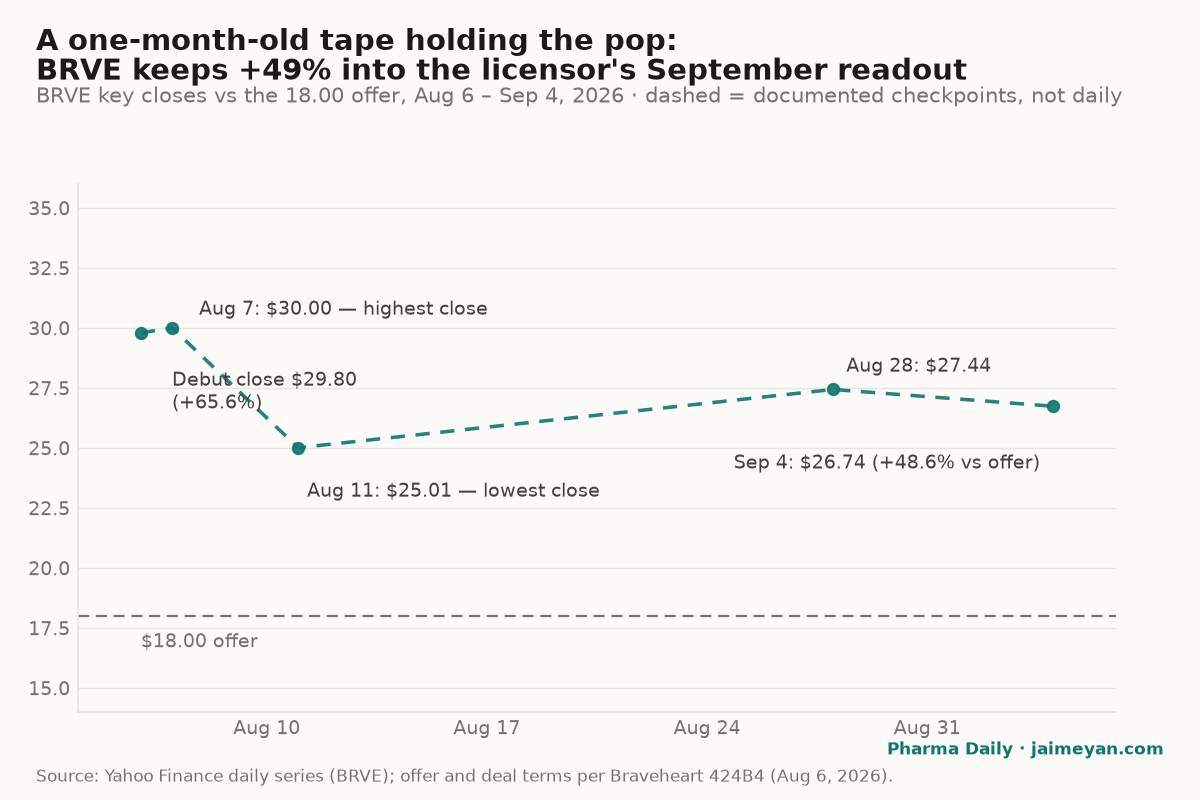
Figure 1: BRVE has traded a tight $25–30 band since debut and holds +48.6% into Hengrui’s China Phase 3 completion window. Documented closes per the Yahoo Finance daily series; dashed segments connect documented checkpoints, not a daily series.
The pairing the class table now offers: two Hengrui in-licensing IPOs, four months apart — Kailera at +1.4%, Braveheart at +48.6%. The variables that differ: asset count (four versus one), licensor data maturity (2028 readouts versus a Phase 3 completing this month), class validation (GLP-1/GIP still chasing tirzepatide versus a myosin inhibitor with two marketed precedents), and upfront cost ($206M versus $58M of cash plus fair-value equity). One month is a thin sample, and we flag it as such — but the early read is that the tape discounts distance to proof, not Chinese origin.
What would change the story
- Hengrui’s China Phase 3 oHCM topline — primary completion September 2026 (NCT07021976). The first pivotal-grade look at the molecule, and it lands before Braveheart’s own Phase 3 even starts.
- LIONHEART-HCM start, 2H 2026, and its 2H 2027 interim.
- LVEF safety in larger populations — the CMI class’s structural risk; Braveheart’s Phase 2 showed no LVEF <50% events in the core period, and every bigger dataset re-tests that.
- Fidelity’s indication — conversion would surface in a future 13G; absence is information too.
One Take
I think Braveheart is the cleanest answer yet to the question this class keeps asking: does China in-licensing carry a structural discount? Kailera said yes; Braveheart, one month in, says no — and I side with Braveheart’s reading, because what the tape actually discounts is unverified distance, not origin. Braveheart closed every gap Kailera left open: a proven drug class instead of a weight-loss shootout, an 86% complete-response Phase 2 with the class’s LVEF safety question answered in the core period (two transient dips in the extension, resolved on dose reduction), a licensor Phase 3 completing within weeks, and a license signed at NewCo prices — $58M of cash plus fair-value equity against Kailera’s $206M package — that leaves the milestone stack to be paid out of success. The risk concentration is equally honest: one asset, one licensor, and a September readout the company doesn’t control. Conviction: moderate-high that BRVE’s next leg is decided by Hengrui’s NCT07021976 topline rather than by anything Braveheart does. Falsifiers: the China Phase 3 missing or slipping (the +48.6% assumes it works), an LVEF signal as exposure broadens past 300 patients, or LIONHEART failing to start this half — the last would say the plan, not just the molecule, is behind.
Key takeaways
- Braveheart priced $382.5M above range on August 5 (21.25M shares at $18.00) and closed at $439.9M gross with a full greenshoe — 1.3x the class median; Fidelity held a $75M non-binding anchor indication.
- The company is a single-asset NewCo (Forbion/OrbiMed) around BHB-1893, a cardiac myosin inhibitor in-licensed from Hengrui for $32.5M cash plus equity — roughly a third of Kailera’s Hengrui upfront package.
- China Phase 2 showed 86% complete response in obstructive HCM with no LVEF <50% events; Hengrui’s China Phase 3 lists primary completion this month.
- The tape: +65.6% debut, a $25.01–30.00 closing band, +48.6% as of September 4 — versus Kailera’s +1.4% on the other Hengrui-fed IPO.
- Pro forma cash of $431.8M funds operations into 2029; Braveheart’s own Phase 3 (LIONHEART-HCM) starts 2H 2026 with an interim guided 2H 2027.
FAQ
Is Braveheart just a Hengrui shell?
It is a single-asset NewCo, but the split of labor is explicit: Hengrui generates China data and currently supplies all clinical drug substance and product (CMC technology transfer is at Hengrui’s cost); Braveheart runs the global Phase 3 program (LIONHEART starts 2H 2026) and holds exclusive rights outside Greater China. Hengrui’s 11.3% stake is non-voting.
How does this differ from Kailera’s Hengrui deal?
Scale and timing. Kailera paid $100M cash plus ~$96.4M in equity upfront for four assets with 2028 readouts; Braveheart paid $32.5M cash plus $25.7M fair-value equity for one Phase 3-ready asset whose licensor-run pivotal trial completes in September 2026. The tapes — +1.4% versus +48.6% as of September 4 — price that difference.
What is the next BRVE catalyst?
Hengrui’s China Phase 3 topline in obstructive HCM (NCT07021976, primary completion September 2026), then the LIONHEART-HCM global Phase 3 start guided for 2H 2026.
Sources
First-hand (filings, releases, registry):
- Braveheart 424B4 final prospectus (21.25M shares at $18.00; Hengrui license terms; Fidelity indication; pipeline) — SEC EDGAR
- Braveheart Announces Closing of Upsized IPO and Full Greenshoe Exercise ($439.9M) — GlobeNewswire via Yahoo Finance, 2026-08-07
- Goodwin advises Braveheart Bio on $439M closing — Goodwin, August 2026
- Hengrui and Braveheart announce the HRS-1893 license (September 5, 2025) — Hengrui Pharmaceuticals
- Hengrui and Braveheart announce positive Phase 2 results in obstructive HCM — PR Newswire via Morningstar, 2026-03-30
- Hengrui and Braveheart announce positive Phase 2 results in non-obstructive HCM — PR Newswire via Morningstar, 2026-05-11
- Braveheart closing 8-K, August 7, 2026 — SEC EDGAR
- Braveheart filing index — SEC EDGAR
- ClinicalTrials.gov: NCT07755904 (BHB-1893 vs metoprolol Phase 3) · NCT07021976 (Hengrui China Phase 3 oHCM) · NCT06816251 (Phase 2 nHCM) · NCT07269717 (Phase 2 HFpEF)
Aftermarket and context:
- The New Biotech IPO Class: Bigger, Later-Stage, and Judged Harder — Pharma Daily (parent analysis; class table and median)
- Cardiovascular diseases biotech Braveheart Bio prices upsized IPO at $18, above the range — Renaissance Capital, August 2026
- Braveheart charges past expectations with $382.5M IPO to fund cardio drug from Hengrui — Fierce Biotech, 2026-08-06
- Kailera’s $625M IPO: The Record That Gave Back the Pop — Pharma Daily (the other Hengrui-fed IPO)
Provenance: collected 2026-09-05. Deal and license figures from the 424B4 and releases above; prices (debut open $30.20 / close $29.80; Aug 7 $30.00; Aug 11 $25.01; Aug 28 $27.44; Sep 4 $26.74) via the Yahoo Finance daily series for BRVE. Percentages vs the $18.00 offer are computed from those closes; our computed first-day return is +65.6% (the class table’s +66.0% is a rounding away). Whether Fidelity’s $75M indication converted is not disclosed post-IPO; we say so rather than assume. No 10-Q exists yet — the first quarterly report covers Q3 2026 — so the cash figures are the 424B4’s pro forma. All performance figures are marked to the September 4, 2026 close and will move with the market.