Avalyn Pharma priced an upsized IPO at the top of its range on April 29, 2026 — 16,666,667 shares at $18.00 for $300 million gross, $345.0M after the greenshoe was exercised in full — and closed its first session up 63.8%. As of the September 4 close the stock trades at $37.39, +107.7% versus offer.
TL;DR — Avalyn (Nasdaq: AVLN — the class table left the ticker unverified; confirmed here from the 8-K cover) is the class’s anti-platform: no discovery engine, no novel modality — proprietary inhaled reformulations of two marketed antifibrotics (pirfenidone and nintedanib) on the 505(b)(2) pathway. The tape has paid steadily: the MIST Phase 2b enrollment completion (+7.3% on June 18) and a Q2 print extending the runway into 2029 (closing high $39.25 on August 14) mark the legs. Cash of $413.5M at June 30. Performance figures are marked to the September 4 close; prices move daily. Caveat: the lead program is a Phase 2b, not a pivotal trial — the efficacy bar for inhaled pirfenidone in progressive pulmonary fibrosis is still unproven at registrational scale, and the topline is H2 2027.
This is a per-company companion to our 2026 IPO class deep-dive, which found the aftermarket rewarding late-stage single-asset stories. Avalyn sharpens the finding: the tape will also pay for de-risked chemistry — a known API with a new route of administration — without any platform narrative at all.
The asset: inhaled pirfenidone, and the 505(b)(2) shortcut that is the whole company
AP01 is Avalyn’s proprietary nebulized formulation of pirfenidone — the same API as oral Esbriet — developed under the 505(b)(2) pathway, which lets Avalyn rely in part on the reference drug’s prior findings. One correction to the parent table’s framing: the lead program is not an IPF Phase 3. AP01’s registrational-track trial is MIST, a global randomized placebo-controlled Phase 2b in progressive pulmonary fibrosis (PPF) — NCT06329401, which completed target enrollment in June (375 planned, 398 actual), with 12-month topline results guided for H2 2027. The IPF evidence is earlier: the ATLAS Phase 1b (91 patients, run 2019–2021 in patients intolerant or ineligible for oral antifibrotics) showed near-stabilization of FVC at 48 weeks on the 100 mg BID dose and fibrosis stabilization or improvement on HRCT in over 70% of evaluated patients, with low rates of the GI and liver-enzyme toxicities commonly seen with oral products; the open-label extension program extends the ATLAS record past 4.5 years of data per the 424B4 (the current extension registry entry, SAIL, NCT06951217, began April 2025).
Behind AP01: AP02, inhaled nintedanib (the Ofev API), in the AURA Phase 2 in IPF (NCT07194382, 160 patients, recruiting; the company guides topline by end of 2027) — and AP03, an inhaled fixed-dose pirfenidone-plus-nintedanib combination entering Phase 1. No in-licensed drug molecule anywhere in the stack: the reformulations are internally developed, and no Roche/Genentech relationship exists despite the shared API. (The 424B4 does disclose an exclusive license with PARI to customize the eRapid/eFlow nebulizer device.)
CEO Lyn Baranowski runs a Boston-based operation (it subleases from CRISPR Therapeutics) that raised ~$389M privately, including a $175M Series C in 2023–24. The pre-IPO register is crossover-heavy: Perceptive Xontogeny (34.1M shares), SR One (27.3M), and Novo Holdings (25.9M) are the largest holders.
The deal: 41% upsized, top of range, full shoe — and no named anchor
| Step | Shares | Price | Gross |
|---|---|---|---|
| S-1 (Apr 8) | blanks | — | — |
| Marketed range (S-1/A, Apr 23) | 11,800,000 | $16–18 | $189–212M |
| Priced (Apr 29) — top of range | 16,666,667 | $18.00 | $300.0M |
| Greenshoe exercised in full (closed May 1) | 19,166,667 | $18.00 | $345.0M |
Table 1: Avalyn pricing steps per the S-1, the S-1/A, the pricing release, and the closing release. Net proceeds ~$316.6M per the Q2 release.
The base deal grew 41% in shares between the April 23 amendment and pricing, at the top of the range, with the syndicate — Morgan Stanley, Jefferies, Evercore ISI, Guggenheim — taking the full 15% greenshoe. Like Hemab and unlike Aktis, no cornerstone was disclosed; the 424B4 notes only that existing holders might participate. At $345M with the shoe, the deal is 1.17x the class median.
The tape: two legs, both earned on execution
AVLN closed its debut at $29.49 (+63.8%) and spent two months range-bound before the first operational proof point: MIST completed enrollment (June 17, +7.3% the next day to $31.45). A midsummer dip marked the lowest close at $25.68 on July 16 — on no disclosed adverse event — before the August 12 Q2 print (cash $413.5M, runway into 2029, ERS abstracts on AP01’s lung tissue distribution) carried the stock to its highest close, $39.25 on August 14. Since then: $34.69 on August 28, $37.39 on September 4.
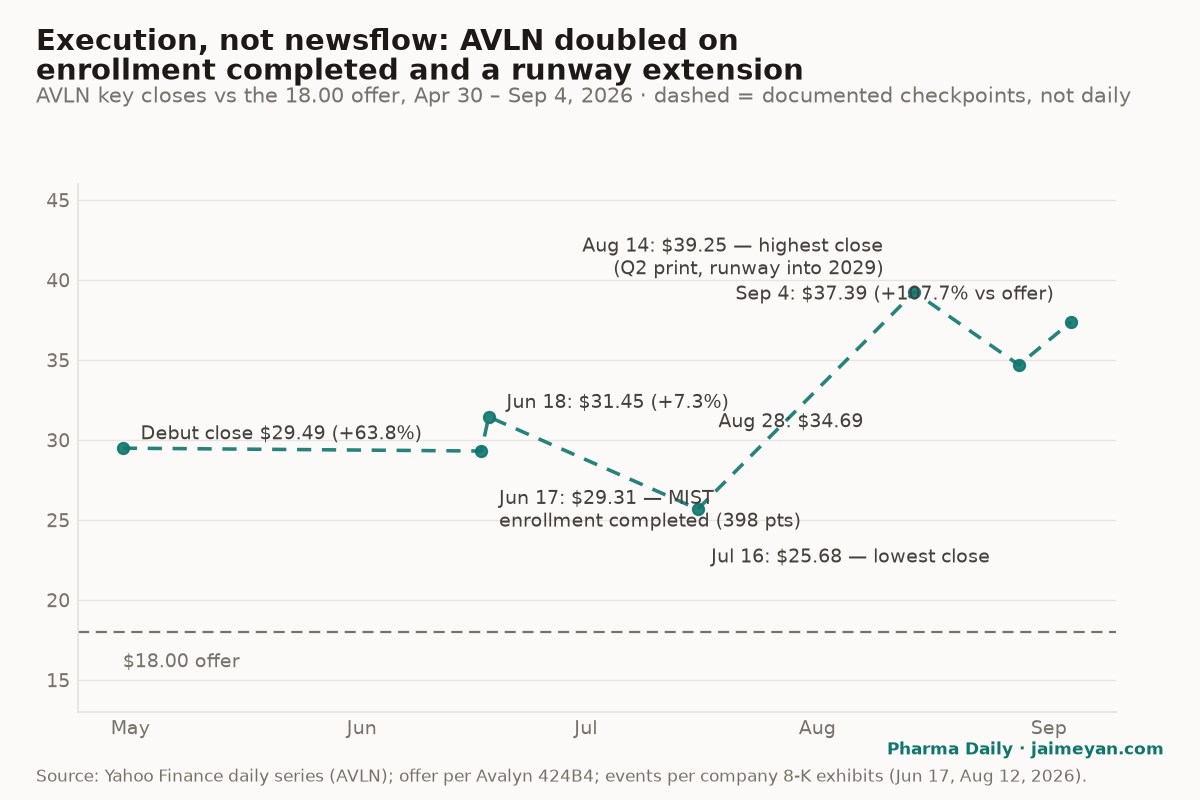
Figure 1: AVLN’s two re-rates came on dated operational disclosures — enrollment completion and the Q2 print — not on clinical data, which have not yet arrived post-IPO. Documented closes per the Yahoo Finance daily series; dashed segments connect documented checkpoints, not a daily series.
Against the class bifurcation: Avalyn is the purest confirmation that what the tape rewards is not novelty but visibility. There is no platform here at all — the entire equity story is a Phase 2b with enrollment done and a date on it. That is exactly the profile the market has paid for all year, and exactly what Eikon and Generate could not offer at pricing.
What would change the story
- MIST topline, H2 2027 (NCT06329401) — the make-or-break readout for AP01 in PPF and the basis for any pivotal filing.
- AURA (AP02) topline by end of 2027 — the second inhaled antifibrotic, in IPF.
- 505(b)(2) reliance — the pathway assumes the reference-drug bridge holds; any FDA friction on the pirfenidone bridge is the structural risk.
- Insider flow — post-IPO 13D/G activity (including a Wellington 13G/A in August) is worth tracking as the register rotates from crossover to long-only.
One Take
Avalyn is the cleanest expression of what the 2026 tape actually buys: not innovation theater, but a clock. A reformulated API on 505(b)(2), an enrolled Phase 2b, a dated readout, and a runway into 2029 — every element is verifiable, and the stock has never needed a platform story to double. My caution is symmetric to the class’s platform winners: the price now assumes MIST works, and the evidence base behind that assumption is a 91-patient Phase 1b in a different population (IPF, not PPF) plus an open-label extension. There is no pivotal data yet, and the +107.7% mark leaves no room for the Phase 2b to merely be mixed. Conviction: moderate that AVLN trades on enrollment and runway mechanics until the H2 2027 topline, because there is nothing else to trade on — no data, no partner catalysts, no platform news flow are scheduled between now and then. Falsifiers: any MIST timeline slip, FDA pushback on the 505(b)(2) bridge, or a financing before the readout despite the stated runway — the last would tell you management marks the trial’s cost higher than the market does.
Key takeaways
- Avalyn priced $300M at the $18 top of range on April 29 (upsized 41%) and closed at $345.0M with the full greenshoe; net proceeds ~$316.6M; no cornerstone disclosed.
- The stock: +63.8% debut, lowest close $25.68 (July 16), highest close $39.25 (August 14), +107.7% vs offer as of September 4.
- The whole company is inhaled reformulations of pirfenidone (AP01, Phase 2b MIST in PPF) and nintedanib (AP02, Phase 2 AURA in IPF) on the 505(b)(2) pathway — no in-license, no platform.
- Both post-IPO legs came on operational disclosures (MIST enrollment completion, June 17; Q2 runway into 2029, August 12), not clinical data.
- Cash of $413.5M at June 30 with runway into 2029 covers the MIST topline (H2 2027) — the raise funds through the readout, unlike several class peers.
FAQ
Is Avalyn’s drug licensed from Roche or Genentech?
No. AP01 is Avalyn’s own nebulized formulation of pirfenidone (the Esbriet API) on the 505(b)(2) pathway; AP02 is inhaled nintedanib (the Ofev API). The 424B4 discloses no licensing relationship with the originators — the reformulations are internally developed.
Why is a Phase 2b company up 108%?
Because the risk is execution-shaped: enrollment is complete (398 patients), the topline is dated (H2 2027), and the cash lasts into 2029. In a class where platform stories broke, a fully scheduled single-asset program is what the market paid for — though the mark now assumes MIST succeeds on evidence that is so far a Phase 1b plus an extension study.
What is the next AVLN catalyst?
MIST 12-month topline in progressive pulmonary fibrosis, guided H2 2027, and AURA (inhaled nintedanib, IPF) by end of 2027. Nothing material is scheduled before those.
Sources
First-hand (filings, releases, registry):
- Avalyn Announces Pricing of Upsized IPO (16,666,667 shares at $18.00) — Avalyn Pharma, 2026-04-29
- Avalyn S-1, April 8, 2026 and S-1/A, April 23, 2026 (11.8M shares at $16–18) — SEC EDGAR
- Avalyn 424B4 final prospectus (pipeline; 505(b)(2) pathway; principal stockholders) — SEC EDGAR
- Avalyn Announces Closing and Full Greenshoe Exercise ($345.0M) — GlobeNewswire, 2026-05-01
- 8-K, June 17, 2026 (MIST enrollment completed; topline H2 2027) — SEC EDGAR
- Q1 2026 results release (MIST enrollment guidance) — SEC EDGAR
- Q2 2026 results release (cash $413.5M; runway into 2029; ERS abstracts) — SEC EDGAR
- Avalyn Q2 2026 10-Q — SEC EDGAR
- ClinicalTrials.gov: NCT06329401 (MIST) · NCT07194382 (AURA) · NCT06951217 (SAIL OLE)
Aftermarket and context:
- The New Biotech IPO Class: Bigger, Later-Stage, and Judged Harder — Pharma Daily (parent analysis; class table and median)
- Avalyn, in pursuit of better lung drugs, banks $300M in an IPO — BioPharma Dive, 2026-04-29
- Avalyn heads to Nasdaq with oversized $300M IPO to fund reformulated respiratory drugs — Fierce Biotech, 2026-04-30
Provenance: collected 2026-09-05. Filing figures from the EDGAR documents above; prices (debut close $29.49; Jun 17 $29.31 → Jun 18 $31.45; Jul 16 $25.68; Aug 14 $39.25; Aug 28 $34.69; Sep 4 $37.39) via the Yahoo Finance daily series for AVLN. Percentages vs the $18.00 offer are computed from those closes; “highest/lowest close” refer to closing prices, not intraday extremes. The ATLAS Phase 1b has no registry record under the current sponsor name; its data are quoted from the 424B4. All performance figures are marked to the September 4, 2026 close and will move with the market.