Attovia Therapeutics priced an upsized IPO at the top of its range on the evening of August 4, 2026 — 17,000,000 shares at $17.00 for $289.0 million gross, $332.4M after the greenshoe was exercised in full two days later — and closed its first session up 28.8%. As of the September 4 close the stock trades at $25.55, +50.3% versus offer, and it has never closed below the offer price.
TL;DR — Attovia (Nasdaq: ATTO) is a confirmed member of the 2026 class: it owns the $289.0M raise the parent table left unassigned. The lead asset is ATTO-1310, a half-life-extended Fc-fusion against IL-31 (the itch cytokine) whose Phase 1b chronic-pruritus cohorts posted week-4 PP-NRS4 response rates of 50% and 78% at the two dose levels against 0% on placebo — early, small-n, but placebo-controlled human efficacy. The raise, upsized 36% with a full greenshoe, funds Phase 2 starts in 1H 2027 and a runway the company now guides into 2030. Performance figures are marked to the September 4 close; prices move daily. Caveat: the efficacy read rests on 26 patients across two chronic-pruritus cohorts, and no Phase 2 has started.
This is a per-company companion to our 2026 IPO class deep-dive, which found the aftermarket rewarding late-stage single-asset stories and punishing platform narratives. Attovia is the useful edge case: a Phase 1-stage company with a platform narrative that got paid anyway.
The asset: anti-IL-31 for itch, with placebo-controlled Phase 1b numbers at pricing
ATTO-1310 is a half-life-extended, ATTOBODY-based Fc-fusion targeting IL-31 — the cytokine that drives itch signaling — with dosing completed in Q1 2026 across healthy volunteers, chronic pruritus, and high-itch atopic dermatitis patients in the Phase 1/1b (NCT06787586, 108 enrolled, an actual figure per the registry, not an estimate; active, not recruiting). The data that carried the book, per the 424B4: in chronic-pruritus cohorts with baseline PP-NRS above 7 (12 patients at 4.5 mg/kg, 14 at 9.0 mg/kg), week-4 PP-NRS4 response — a ≥4-point itch reduction — hit 50% at the low dose, 78% at the high dose, 65% pooled, versus 0% on placebo at all timepoints; near itch-free (PP-NRS below 2) by week 4 in 25% and 44% respectively. Significance was nominal (p<0.05 from week 2 pooled, week 3 at the high dose), as expected at this n. Planned indications run pan-pruritic: chronic pruritus of unknown origin, high-itch AD, cholestatic pruritus in PBC and PSC, and uremic pruritus. Phase 2 trials in CPUO and high-itch AD are slated to start in 1H 2027; complete Phase 1b data are guided for Q4 2026.
Behind the lead: ATTO-2306, an IL-13 × IL-31 bispecific (anti-IL-13 arm derived from lebrikizumab, YTE half-life extension) in IND-enabling work with Phase 1 planned 1H 2027 — the designated successor to the deprioritized ATTO-3712 — and ATTO-1091, a trispecific blocking TL1A, IL-23, and integrin α4β7 for IBD, also IND-enabling. Every candidate is internally discovered on the ATTOBODY biparatopic platform, in-licensed from Alamar Biosciences in June 2023 (Alamar took 2,428,646 common shares plus milestones and royalties; it remains a 7.5% holder post-IPO). The company was founded in 2023, is run by CEO/founder Tao Fu out of San Carlos, and had 44 employees at June 30, 2026.
The deal: 36% upsized, top of range, full shoe — the class’s missing $289M
| Step | Shares | Price | Gross |
|---|---|---|---|
| Marketed range (S-1/A, Jul 29) | 12,500,000 | $15–17 | $188–213M |
| Priced (Aug 4) — top of range, upsized | 17,000,000 | $17.00 | $289.0M |
| Greenshoe exercised in full (closed Aug 6) | 19,550,000 | $17.00 | $332.4M |
Table 1: Attovia pricing steps per the S-1/A of July 29, the S-1/A of August 4, the 424B4, and the closing release. Net proceeds ~$305.4M are the 10-Q actual per the Q2 2026 10-Q, not a prospectus estimate.
One correction to the parent article: its 21-row class table left $289.0M unassigned. That raise is Attovia’s (17.0M shares × $17.00 base gross); with the fully exercised greenshoe the total gross is $332.4M. The base deal alone is 0.98x the class median of $295M; with the shoe, 1.1x.
Demand showed up in the structure: the share count grew 36% between the July 29 amendment and pricing, at the top of the range, and the syndicate — Morgan Stanley, Leerink Partners, Citigroup, and RBC Capital Markets, with LifeSci Capital as co-manager — took the entire 15% greenshoe, closing 19.55M shares on August 6. These are confirmed purchases, not non-binding anchor indications: Frazier funds bought 1,250,000 shares in the offering at $17.00 ($21.25M across three vehicles) per the Frazier 13D, then added in the open market on August 5–7; Deep Track Capital disclosed 3,207,138 shares (7.45%) in a 13G. Proceeds are earmarked $110–130M for ATTO-1310 through Phase 2 and $60–80M for ATTO-2306 through Phase 2 in AD. The deal landed well above the initial ask: Fierce Biotech reports the company had hoped for roughly $182.4M at the marketed size and range before two upsizings.
The tape: never below offer, and the re-rate came on the runway print
ATTO closed its August 5 debut at $21.90 (+28.8% vs the $17.00 offer, after a $21.00 open) and dipped to its lowest close, $18.06 on August 12 — still +6.2% above offer — before grinding higher into the September 2 Q2 print. That print (cash and securities of $115.1M at June 30 plus ~$305.4M in net IPO proceeds, runway guidance extended from “into 2029” in the prospectus to “into 2030”) carried the stock $22.22 → $23.13 on September 2 (+4.1%), then $24.20 on September 3 and $25.55 on September 4 — the highest close, +50.3% versus offer. All figures are closing prices, marked to September 4.
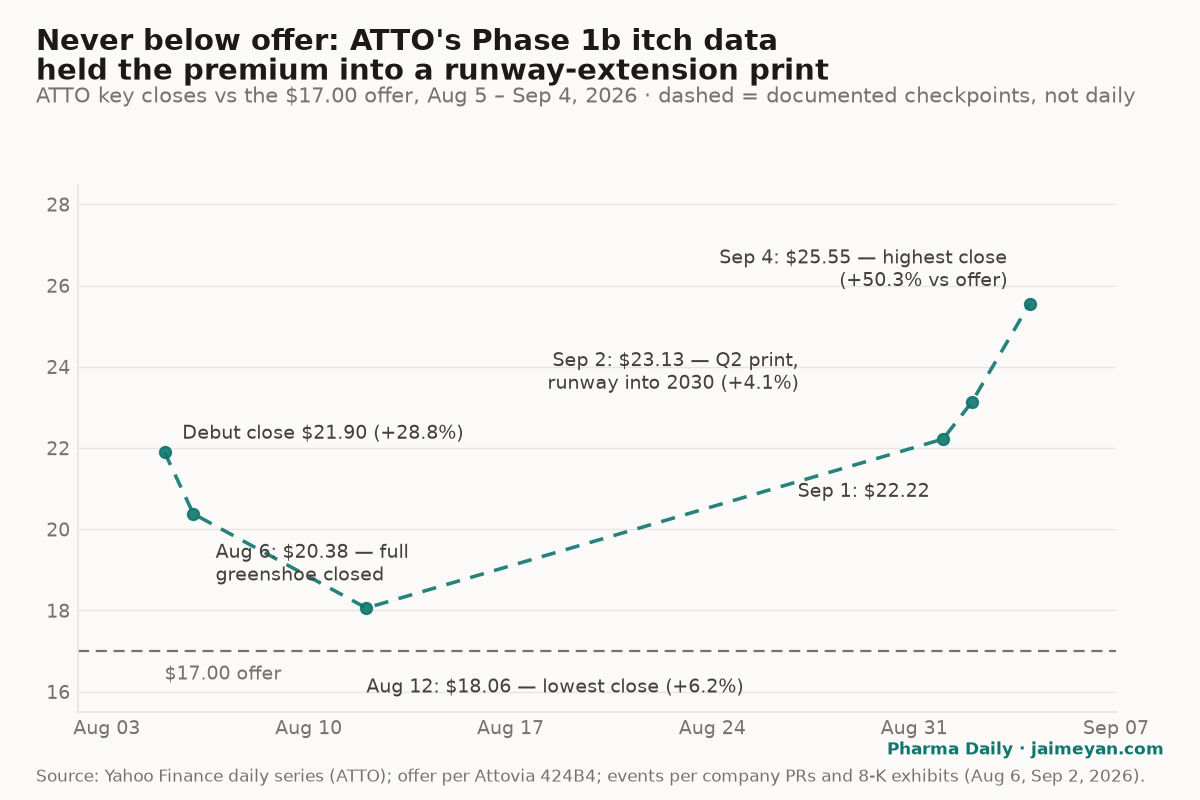
Figure 1: ATTO never closed below its $17.00 offer; the September leg followed the Q2 print and the runway extension, not new clinical data. Documented closes per the Yahoo Finance daily series; dashed segments connect documented checkpoints, not a daily series.
Against the class bifurcation, Attovia refines rather than confirms. It is the earliest-stage winner in the class coverage so far — a Phase 1/1b lead, two IND-enabling programs, and an explicit platform story in the ATTOBODY biparatopic engine — the exact profile that sank Eikon and Generate below offer. The difference is what the platform had already produced: placebo-controlled efficacy on the lead asset at pricing, plus a syndicate and insider base (Frazier buying in the deal and after it) willing to underwrite the platform narrative. The tape punished platforms that were promises; it paid for one that arrived with human data attached.
What would change the story
- Complete Phase 1b data, Q4 2026 — the first full look at durability and the AD cohorts beyond the 26-patient pruritus cut in the prospectus.
- Phase 2 starts in CPUO and high-itch AD, 1H 2027 — the first test of whether the PP-NRS4 signal survives a powered, randomized design.
- ATTO-2306 and ATTO-1091 Phase 1 starts, 1H 2027 — the platform-proof points; a slip here reopens the “one-asset company” question.
- Register rotation — Frazier’s post-IPO open-market adds and Deep Track’s 7.45% position make 13D/G amendments the tell on crossover conviction.
One Take
Attovia is the refinement the parent’s bifurcation finding needed: the 2026 tape does not punish platforms categorically — it punishes platforms without a de-risked lead. ATTO-1310 arrived at pricing with placebo-controlled Phase 1b response rates (78% PP-NRS4 at the high dose versus 0% on placebo), and the $332.4M all-in raise funds the company into 2030, past the Phase 2 readouts that will actually decide the asset. My conviction is moderate that ATTO holds its premium into the Q4 2026 complete-data readout, because the register is insider-anchored (Frazier bought in the deal and added after it) and nothing dilutive is scheduled before the Phase 2 starts. What the mark already assumes is that 26 patients scale: a Phase 1b itch signal in a heterogeneous chronic-pruritus population is a long way from a powered CPUO trial, and the +50.3% mark leaves little room for a merely-consistent dataset. Falsifiers: the complete Phase 1b cut failing to hold the PP-NRS4 rates, any slip of the 1H 2027 Phase 2 starts, or a return to market for cash before those readouts despite the stated 2030 runway.
Key takeaways
- Attovia priced $289.0M at the $17.00 top of range on August 4 (upsized 36% in shares) and closed at $332.4M with the full greenshoe — 0.98x the class median at base, 1.1x all-in; net proceeds ~$305.4M per the 10-Q.
- The stock: +28.8% debut close, lowest close $18.06 (August 12), highest close $25.55 (September 4), +50.3% vs offer as of September 4 — never a close below offer.
- The lead is ATTO-1310 (anti-IL-31, Phase 1/1b): week-4 PP-NRS4 of 50%/78% at 4.5/9.0 mg/kg vs 0% placebo in 26 chronic-pruritus patients — small-n, nominally significant.
- The September leg came on the Q2 print (runway extended into 2030), not clinical data; Phase 2 starts and two platform Phase 1s are all scheduled for 1H 2027.
- Attovia refines the class bifurcation: the tape paid for a platform story because it arrived with placebo-controlled human efficacy on the lead asset — contrast Eikon and Generate, priced as promises and marked down.
FAQ
Did Attovia actually IPO in 2026?
Yes. It priced on August 4, 2026 at $17.00 per share and began trading on Nasdaq under ATTO on August 5; the parent class table simply omitted the row, leaving its $289.0M raise unassigned.
Why is a Phase 1 company up 50%?
Because the Phase 1b was placebo-controlled and positive on the lead asset (78% week-4 PP-NRS4 at 9.0 mg/kg vs 0% placebo), and the raise funds operations into 2030 — past the Phase 2 readouts. The 2026 tape has paid for dated, funded next steps even at early stage.
What is the next ATTO catalyst?
Complete Phase 1b data for ATTO-1310 in Q4 2026, then Phase 2 starts in CPUO and high-itch atopic dermatitis in 1H 2027; Phase 1 starts for ATTO-2306 and ATTO-1091 are also guided for 1H 2027.
Sources
First-hand (filings, releases, registry):
- Attovia 424B4 final prospectus (pricing; pipeline; Phase 1b data; principal stockholders; use of proceeds) — SEC EDGAR, 2026-08-05
- S-1/A, July 29, 2026 (12.5M shares at $15–17) and S-1/A, August 4, 2026 (17.0M shares at $17.00) — SEC EDGAR
- Attovia Announces Pricing of Upsized IPO — GlobeNewswire, 2026-08-05
- Closing of IPO and Full Exercise of Underwriters’ Option (19.55M shares) — GlobeNewswire, 2026-08-06
- Q2 2026 10-Q (cash $115.1M; net IPO proceeds ~$305.4M; net loss; R&D) — SEC EDGAR, filed 2026-09-02
- Q2 2026 results release (Phase 1b complete data Q4 2026; Phase 2 and Phase 1 starts 1H 2027; runway into 2030) — SEC EDGAR, 2026-09-02
- Frazier 13D (IPO purchase of 1,250,000 shares; open-market adds; reverse split) — SEC EDGAR, 2026-08-11
- Deep Track 13G (3,207,138 shares, 7.45%) — SEC EDGAR, 2026-08-12
- ClinicalTrials.gov: NCT06787586 (ATTO-1310 Phase 1/1b, 108 enrolled — actual)
Aftermarket and context:
- The New Biotech IPO Class: Bigger, Later-Stage, and Judged Harder — Pharma Daily (parent analysis; class table and median)
- Attovia adds to biotech IPO momentum with $289M offering — BioPharma Dive, 2026-08-05
- Attovia’s CEO aims to scratch itch opportunity and challenge Dupixent with $289M IPO — Fierce Biotech, 2026-08-05
- Attovia debuts on Nasdaq (opening print $21.00) — Qiming Venture Partners, 2026-08-05
Provenance: collected 2026-09-05. Filing figures from the EDGAR documents above; prices (debut close $21.90; Aug 6 $20.38; Aug 12 $18.06; Sep 1 $22.22 → Sep 2 $23.13; Sep 3 $24.20; Sep 4 $25.55) via the Yahoo Finance daily series for ATTO. Percentages vs the $17.00 offer are computed from those closes; “highest/lowest close” refer to closing prices, not intraday extremes. Event dates are used as event dates; the Q2 figures are from the 10-Q filed September 2, 2026. All performance figures are marked to the September 4, 2026 close and will move with the market.