Apnimed priced an upsized IPO at the top of its marketed range on July 30, 2026 — 12,000,000 shares at $16.00 for $192.0 million gross, $220.8M after the underwriters exercised the full greenshoe at the August 3 closing — and closed its first session on July 31 at $25.00, up 56.3% versus offer. As of the September 4 close, APMD trades at $27.45, +71.6% versus offer.
TL;DR — Apnimed (Nasdaq: APMD) is the purest late-stage profile in the class: one asset, AD109 (proposed brand name Oxnimbi — the name was conditionally approved by the FDA; the NDA itself remains under review), an oral pill for obstructive sleep apnea with both registrational Phase 3 trials completed in 2025 and an NDA already under FDA review — PDUFA goal date February 28, 2027. One note on the parent class analysis: its prose groups Apnimed among “Phase 3 or Phase 3-ready” names; at pricing it was NDA-stage, the NDA having been accepted on July 14, 2026. The tape: +56.3% debut close, a highest close of $32.55 on August 17 (+103.4% vs offer), +71.6% vs offer as of September 4 — with three double-digit daily moves on no disclosed company news. Caveats: the FDA questioned the clinical meaningfulness of the trial results at the pre-NDA meeting, the SynAIRgy AE-discontinuation rate was 21.2% versus 3.1% on placebo, and no 10-Q has been filed yet — net proceeds (~$200.4M with the full shoe) are the prospectus estimate. Performance figures are marked to the September 4, 2026 close; prices move daily.
This is a per-company companion to our 2026 IPO class deep-dive, which found the aftermarket rewarding late-stage single-asset stories and punishing platform narratives. Apnimed tests the finding at its extreme: there is nothing left to de-risk clinically except the regulator itself.
The asset: one pill, two completed Phase 3s, and an FDA question mark
AD109 — Oxnimbi — is a once-nightly oral fixed-dose tablet combining aroxybutynin 2.3 mg (a novel anti-muscarinic) with atomoxetine 75 mg (a selective norepinephrine reuptake inhibitor; a 2.3 mg/37.5 mg lower dose was also developed). The mechanism targets the neuromuscular defect of obstructive sleep apnea: improving upper-airway muscle activity to keep the airway open during sleep. The indication is adult OSA across mild-to-severe disease; the 424B4 sizes the affected population at roughly 80 million US adults and about 1 billion worldwide.
The registrational package is done. SynAIRgy (NCT05813275, US/Canada, 646 patients per the registry entry, completed March 2025) and LunAIRo (NCT05811247, US, 660 patients, completed May 2025) both met their primary endpoint. At Week 26 on the treatment-policy estimand, mean AHI₄ reduction was 44.1% (SynAIRgy) and 33.7% (LunAIRo) versus 17.6% and 7.3% on placebo (p≤0.0001); hypoxic burden fell 44.7% and 37.4% (p<0.001). Tolerability is the soft spot in the label-to-be: no drug-related serious adverse events, but AE-driven discontinuation ran 21.2% versus 3.1% on placebo in SynAIRgy — the 424B4’s most common Phase 3 treatment-related AEs were dry mouth, insomnia, and nausea (urinary hesitancy appears in the Phase 2/OLE discussion, not the Phase 3 most-common list) — with insomnia the leading discontinuation cause (4.9% SynAIRgy, 3% LunAIRo). An open-label extension (NCT06566820, registry enrollment figure 1,280) is enrolling by invitation.
The regulatory risk is explicit in the prospectus: at the pre-NDA meeting, the FDA questioned the clinical meaningfulness of the endpoint results — including the primary endpoint and limitations of the patient-reported outcomes — and additional analyses or justification may be needed. The NDA was submitted in April 2026 and accepted on July 14, 2026, with a PDUFA goal date of February 28, 2027.
Around the asset, the corporate story is unusually tidy. The foundational science came out of Brigham and Women’s Hospital/Harvard (co-founder Luigi Taranto Montemurro’s work; BWH license dated December 29, 2020, amended July 27, 2023). The rest of the pipeline is effectively inactive: the Shionogi joint venture (“SASS,” formed November 2023) was sold back to Shionogi in April 2026 for a $100M closing payment plus milestone and earnout rights, and a secured credit facility of up to $150M with Stafford Fund II, L.P. and HCR Potomac Fund II, L.P. (HCR OSA SPV as agent; “HealthCare Royalty Partners” per AllSci’s coverage; April 2026; $50M Tranche A drawn) sits alongside the equity. Kevin R. Lind — co-founder and former CEO of Longboard Pharmaceuticals — took over as CEO in June 2026, weeks before pricing; the company had 65 full-time employees as of March 31, 2026, and had raised roughly $389.1M in private capital.
The deal: 20% upsized, top of range, full shoe — and 13G-confirmed buying
| Step | Shares | Price | Gross |
|---|---|---|---|
| Initial S-1 (Jul 10) | no terms | — | no stated amount |
| Marketed range (S-1/A, Jul 27) | 10,000,000 | $14.00–16.00 | $140–160M |
| Priced (Jul 30) — top of range, upsized 20% | 12,000,000 | $16.00 | $192.0M |
| Greenshoe exercised in full (closed Aug 3) | 13,800,000 | $16.00 | $220.8M |
Table 1: Apnimed pricing steps per the S-1, the S-1/A, the pricing release, and the closing release. Estimated net proceeds ~$173.6M base / ~$200.4M with the full greenshoe per the 424B4 — an estimate; no 10-Q with actuals has been filed yet.
The base deal grew 20% in shares between the July 27 amendment and pricing, at the top of the range, and the syndicate — BofA Securities, Evercore ISI, Cantor, and LifeSci Capital as joint book-runners — took the full 15% greenshoe (1,800,000 shares) at the August 3 closing, confirmed by the closing release. At $220.8M total gross the deal is 0.7x the class median of $294.8M (a 21-deal class; n<30) — below the middle of the class on size, though it funded against a much later-stage asset than most.
No anchor or cornerstone tranche was disclosed in the 424B4, but post-IPO 13Gs confirm existing holders added real money rather than merely indicating interest: Ameriprise Financial/Columbia Management reported 7,476,992 shares (18.9%) in a 13G filed August 7, up from 4,298,843 pre-IPO, and Tao Capital reported 2,178,138 shares (5.2%) in a 13G filed August 6, up from 1,865,638 pre-IPO. Director Paul Sekhri bought 12,500 shares at the $16.00 offer price on August 3 (~$200,000), per his Form 4. Insiders and 5% holders together held roughly 85% pre-IPO and about 59% after the offering.
The balance-sheet math, per the 424B4: cash and equivalents of $46.9M at March 31, 2026, and pro forma as-adjusted cash plus short-term investments of $394.7M after the Shionogi closing payment, Tranche A, and the IPO with full greenshoe. Management guides that existing cash plus IPO proceeds fund operations through June 2028 — comfortably past the PDUFA date.
The tape: a +56% debut and three double-digit swings on no news
APMD opened its debut session at $22.00 and closed July 31 at $25.00, +56.3% versus the $16.00 offer. The lowest close since pricing is $24.87 (August 11, +55.4% vs offer); the highest close is $32.55 (August 17, +103.4%). Since then the stock has given back part of the peak: $29.71 on August 28 (+85.7%) and $27.45 on September 4 (+71.6%).
The striking feature is what is missing: news. The only 8-K since the IPO is an August 3 housekeeping filing (restated certificate of incorporation and amended bylaws effective at the close). No 10-Q, no earnings release, no clinical 8-K. Against that silence, the stock posted a +10.3% session on August 14 (to $31.75), a −10.9% session on August 20 (to $28.55), and a −11.6% session on August 31 (to $26.25); we found no company press release or filing around any of the three.
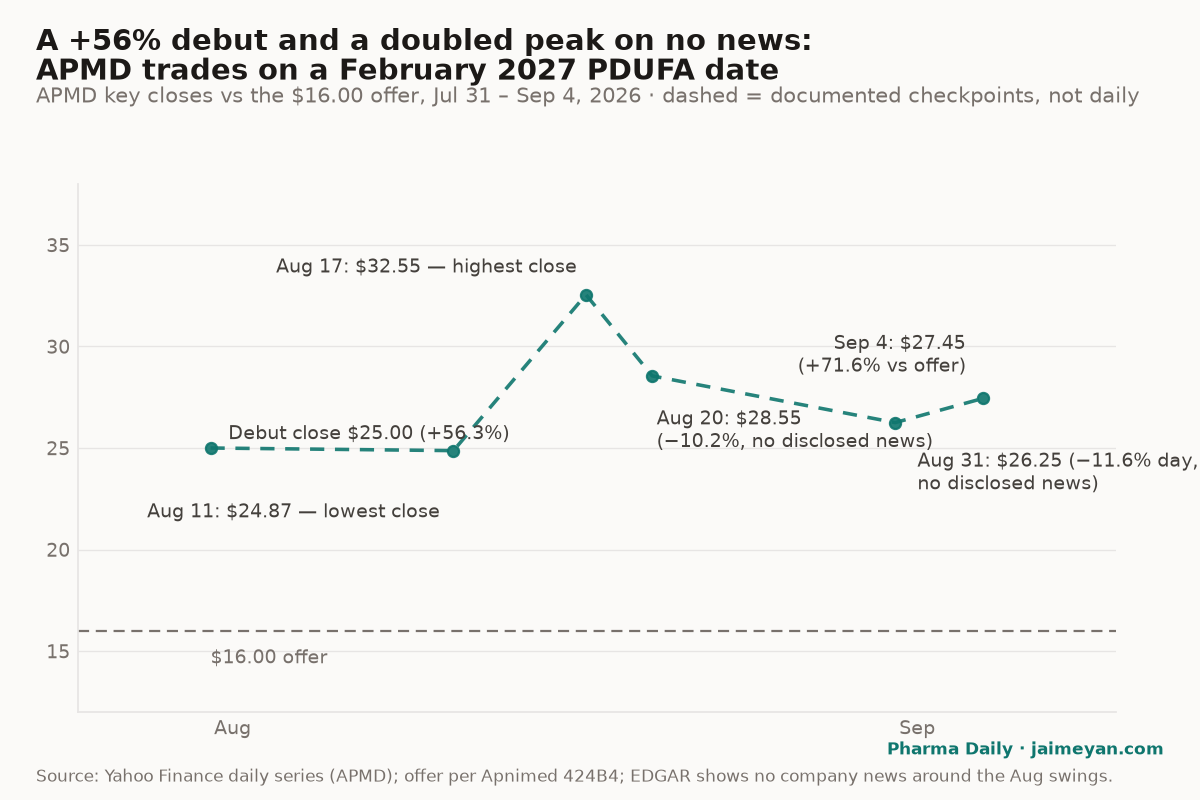
Figure 1: APMD’s debut pop and mid-August peak arrived with no company disclosures — the stock is trading the February 2027 FDA decision, not newsflow. Documented closes per the Yahoo Finance daily series; dashed segments connect documented checkpoints, not a daily series.
Against the class bifurcation, Apnimed is a confirmation, not an exception. The entire equity story is one asset, one regulator, one date — the exact opposite of the platform narratives that broke below offer at Eikon and Generate. Where Avalyn’s tape legs were earned on operational disclosures, Apnimed’s have required none: the market is paying for the visibility of a completed package under active review.
What would change the story
- PDUFA, February 28, 2027 — the binary. Approval makes Oxnimbi the first oral pharmacotherapy aimed at OSA’s neuromuscular defect; a complete response letter resets the company around whatever the FDA asks for next.
- The clinical-meaningfulness question — the pre-NDA pushback on the endpoints (including the PRO limitations) is the documented path to a delayed or narrowed approval even if the drug clears.
- The label, if approved — a 21.2% AE-discontinuation rate in SynAIRgy is the number that will shape real-world persistence and any label language on tolerability.
- The first 10-Q — none has been filed since the IPO. It will replace the prospectus estimates (~$200.4M net proceeds; $394.7M pro forma cash as of March 31) with actuals and test the “through June 2028” runway guidance.
- Launch buildout — 65 full-time employees as of March 31 is a discovery-stage headcount facing a potential commercial launch; hiring and partnering decisions are the tell.
One Take
Apnimed is the strongest confirmation in this series of the parent’s bifurcation finding: the 2026 tape pays for a single late-stage asset with a dated binary, and here the asset is one FDA signature from market with the clinical work already finished. The stock is, functionally, a PDUFA derivative — three double-digit sessions on zero disclosures tells you the float is trading the February 28 decision and nothing else. My conviction is high that APMD trades on the review clock until the PDUFA, and moderate that the current +71.6% mark (as of the September 4 close) underweights the two documented soft spots: the FDA’s stated doubts about clinical meaningfulness, and a 21.2% AE-discontinuation rate that will decide whether an approval turns into a durable franchise or a high-attrition launch. Falsifiers: a PDUFA extension or CRL, a label that restricts the mild-to-moderate population where the commercial math lives, or a financing before the decision despite the guided runway through June 2028 — the last would signal management prices the launch build heavier than the market does. Note this cuts both ways: with no scheduled catalysts between now and February, any adverse FDA communication lands on a stock with no other story to hold it.
Key takeaways
- Apnimed priced $192.0M at the $16.00 top of range on July 30 (upsized 20%) and closed at $220.8M with the full greenshoe on August 3 — 0.7x the class median of $294.8M (21-deal class; n<30); estimated net proceeds ~$200.4M (prospectus estimate; no 10-Q filed yet).
- The tape as of September 4: +56.3% debut close, highest close $32.55 (August 17), lowest close $24.87 (August 11), latest $27.45 — +71.6% versus offer, with three double-digit daily moves on no disclosed company news.
- AD109/Oxnimbi is a once-nightly oral aroxybutynin/atomoxetine tablet for OSA; both Phase 3s (SynAIRgy, LunAIRo; ~1,300 patients combined) completed in 2025 and met their primary endpoints; the NDA was accepted July 14, 2026 with a February 28, 2027 PDUFA.
- The documented risks are regulatory, not clinical-timeline: FDA questioned the clinical meaningfulness of the results at the pre-NDA meeting, and AE discontinuation ran 21.2% versus 3.1% on placebo in SynAIRgy.
- Pro forma cash plus short-term investments of $394.7M (as-adjusted, March 31, 2026) and guided runway through June 2028 mean the raise funds the company past the FDA decision and into a launch buildout.
FAQ
What is AD109 (Oxnimbi)?
A once-nightly oral fixed-dose tablet — aroxybutynin 2.3 mg plus atomoxetine 75 mg — that targets the neuromuscular defect underlying obstructive sleep apnea rather than airway mechanics. Both registrational Phase 3 trials completed in 2025 and met their primary endpoints; the NDA is under FDA review with a PDUFA goal date of February 28, 2027.
Why is Apnimed up 72% with no post-IPO news?
Because the catalyst is already scheduled: the company went public NDA-stage with a fixed FDA decision date, which is exactly the late-stage single-asset profile the 2026 aftermarket has rewarded. Since pricing, Apnimed has filed only one housekeeping 8-K — the +71.6% mark versus offer (as of the September 4 close) reflects the February 2027 decision being priced in, not any new disclosure.
What is the biggest risk to the Apnimed story?
The FDA’s pre-NDA feedback questioning the clinical meaningfulness of the trial results, including the primary endpoint — it creates a path to a delayed or narrowed approval despite both Phase 3s hitting their endpoints. Secondarily, tolerability: 21.2% of SynAIRgy patients discontinued for adverse events, which will shape the label and launch persistence if approved.
Sources
First-hand (filings, releases, registry):
- Apnimed Announces Pricing of Upsized IPO (12,000,000 shares at $16.00) — Apnimed IR, 2026-07-30
- Apnimed Announces Closing of Upsized IPO and Full Exercise of Greenshoe (13,800,000 shares, $220.8M gross) — Apnimed IR, 2026-08-03
- Apnimed S-1, July 10, 2026 and S-1/A, July 27, 2026 (10.0M shares at $14–16) — SEC EDGAR
- Apnimed 424B4 final prospectus (efficacy and safety data; FDA pre-NDA feedback; pro forma cash; runway; principal stockholders; net-proceeds estimates) — SEC EDGAR
- Apnimed 8-K, August 3, 2026 (restated certificate; amended bylaws) — SEC EDGAR
- Ameriprise Financial/Columbia Management 13G, filed August 7, 2026 (7,476,992 shares, 18.9%) and Tao Capital 13G, filed August 6, 2026 (2,178,138 shares, 5.2%) — SEC EDGAR
- Apnimed EDGAR filing index (CIK 0001745648) — SEC EDGAR
- ClinicalTrials.gov: NCT05813275 (SynAIRgy) · NCT05811247 (LunAIRo) · NCT06566820 (open-label extension)
Aftermarket and context:
- The New Biotech IPO Class: Bigger, Later-Stage, and Judged Harder — Pharma Daily (parent analysis; class table and median)
- With sleep apnea drug under review, Apnimed prices $192M IPO — BioWorld, 2026-08-04 (note: the piece states a 1.5M-share overallotment; the closing release and 424B4 confirm 1.8M)
- Apnimed prices IPO of 12 mln shares at $16 per share — RTT News, 2026-07-30
- AD109 approval-history timeline (NDA accepted July 14, 2026; PDUFA February 28, 2027) — Drugs.com
- Phase 3 SynAIRgy data and mechanistic review of AD109 — NeurologyLive
- Director Paul Sekhri Form 4 purchase reported (12,500 shares at $16.00, August 3, 2026) — 10jqka, 2026-08-04
- Apnimed–HealthCare Royalty Partners $150M credit facility — AllSci
Provenance: collected 2026-09-05. Filing figures from the EDGAR documents and company releases above; prices (debut close $25.00 on Jul 31; Aug 11 $24.87; Aug 14 $31.75; Aug 17 $32.55; Aug 20 $28.55; Aug 28 $29.71; Aug 31 $26.25; Sep 4 $27.45) via the Yahoo Finance daily series for APMD. Percentages versus the $16.00 offer are computed from those closes; “highest/lowest close” refer to closing prices, not intraday extremes. Trial enrollment figures (SynAIRgy 646, LunAIRo 660, extension 1,280) are the ClinicalTrials.gov registry numbers, consistent with the ~1,300-patient combined figure in the 424B4. Net-proceeds figures are prospectus estimates — no 10-Q with actuals had been filed as of collection. The BioWorld overallotment figure (1.5M shares) conflicts with the closing release (1.8M); we use the company’s number. All performance figures are marked to the September 4, 2026 close and will move with the market.