Ask your favorite AI coding agent — Claude Code, Cursor, Cline, Augment Code — to review the SAS log from an ADSL derivation. It will happily try. Now ask it to read the SAS7BDAT dataset itself, parse the ADaM specification Excel, or tell a real ERROR: apart from a harmless “Unable to copy SASUSER” warning. It can’t — not because the model can’t reason, but because none of the domain tools exist.
That gap — tooling, not reasoning — is what the ClinAgent architecture in my medRxiv preprint is built to close. The design rule is one sentence: thin MCP, thick skills.
TL;DR — ClinAgent is a five-layer stack that gives any MCP-compatible agent clinical programming capability: stateless MCP tools for data access, thick and testable skills for domain logic, and an infrastructure layer for the GxP compliance trail. Validated on a production Phase 2 study, all nine skills passed functional testing.
The five layers
ClinAgent is not an agent. It is a skill-and-tool layer that any MCP-compatible agent can invoke, organized as five layers:
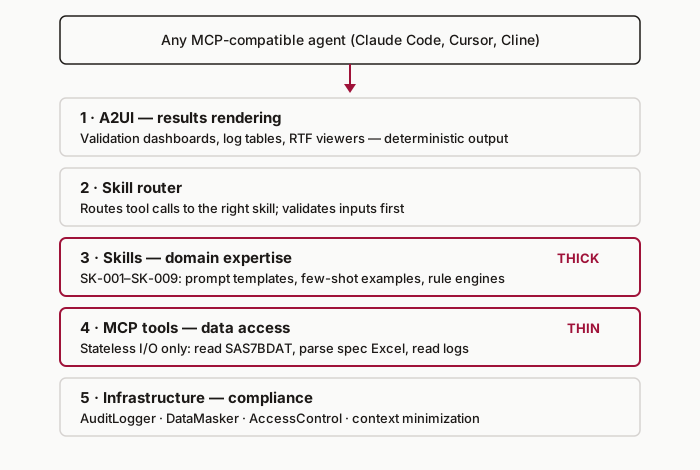
Figure 1: The ClinAgent stack. The agent reasons; the layers below supply domain expertise, deterministic rules, and the compliance trail.
- A2UI (results rendering) — validation dashboards, log tables, RTF viewers: deterministic presentation of results for human review.
- Skill router — maps incoming tool calls to the right skill and validates inputs before anything executes.
- Skills (thick) — nine packages, SK-001 Study Setup through SK-009 eSub Packaging. Each bundles an embedded prompt template, few-shot examples, constraint specs, a deterministic rule engine, and the MCP tool bindings it needs.
- MCP tools (thin) — stateless I/O only: read a SAS dataset, parse an Excel spec, read a log file. They don’t know what ADSL is or which variables matter.
- Infrastructure — AuditLogger (every tool invocation with timestamps, inputs, outputs), DataMasker (PHI/PII stripped before data reaches agent context), AccessControl, and context minimization.
The agent does the reasoning. ClinAgent supplies the domain expertise and the compliance trail. Swap the agent — whichever one your organization approved — and the skill layer keeps working unchanged.
Why thick skills beat fat prompts
The obvious alternative is to stuff everything into one giant prompt — CDISC rules, error patterns, derivation conventions, QC logic — and hand it to the agent. I deliberately didn’t do that, for reasons that become concrete the moment you try to maintain such a system:
- Testability. Rules buried in a prompt (or compiled into an MCP server) can only be exercised end-to-end with real files and a model in the loop. Rules in skill-side JSON are unit-testable with plain fixtures — no LLM call required.
- Evolvability. CDISC standards change and new SAS error patterns emerge. When a new warning pattern appears, the fix is one line in
warning_patterns.json— no code change, no redeployment, no regression on the data-access layer. - Transparency. A fat prompt is a black box even to its author. A JSON rule file is something a domain expert — a senior statistical programmer, not a software engineer — can read, review, and sign off on. In GxP work, that reviewability is the validation story.
- Determinism where it matters. Agent reasoning is stochastic, which is fine for writing a summary. It is not fine for classifying an
ERROR:line or checking a dataset against its spec. So the skill splits the work: the rule engine classifies deterministically, and only then does the LLM write the human-readable interpretation:
"rule_engine": {
  "error_patterns": ["^ERROR:", "^ERROR [0-9]+-"],
  "warning_patterns": ["^WARNING:"],
  "false_positive_warnings": ["Unable to copy SASUSER",
                              "BY-line has been truncated"]
}
Extensibility falls out of the same choice. Adding a new capability (the preprint walks through a hypothetical SK-010 define.xml generator) is primarily configuration — a skill JSON plus rules and prompt template — reusing the existing MCP tools untouched.
What the validation showed
I validated all nine skills on artifacts from a production Phase 2 cardiovascular study: expert-written SAS programs, reviewed logs, and synthetic Faker-generated datasets matching the study structure (11 ADaM domains, 93,239 observations — no patient data). The evaluation targets tool correctness, not LLM reasoning, which is agent-dependent and out of scope. All nine skills passed functional validation.
| Skill | Task | Result |
|---|---|---|
| SK-005 log analysis | Classify errors/warnings in 10 reviewed logs | 1 error, 7 warnings; 100% precision, zero false positives over 13,595 clean NOTE lines |
| SK-006 data validation | Check ADSL against its specification | 56/56 variables matched |
| Spec generation | Derive ADaM specs (prompt-based component) | 72.1% derivation accuracy (95% Wilson CI [67.1%, 76.7%]); above 96% on ADMH, ADEX, ADCM |
| SK-007 TLF generation | Generate TLF programs from specs | 12/16 generated; 4 skipped because specs lacked macro names |
Table 1: Functional validation on the Phase 2 study artifacts. The four skipped TLFs were a data-quality issue in the input specs, not a skill failure.
The most interesting result is the failure mode. Derivation accuracy correlates strongly and negatively with the proportion of study-specific derived variables (Spearman ρ = −0.867, p = 0.003): ADSL hit 54.3% and ADBASE — almost entirely custom baseline flags — hit 0.0%. Of the 115 missing variables, 58.3% were study-specific derivations that no generic prompt can know about. That is exactly the knowledge that belongs in a thick, organization-specific skill, not in a fatter generic prompt.
Honest limitations
The preprint is explicit about what this does not show. It’s a single Phase 2 study; the log-detection result rests on exactly one real error (Wilson CI [20.7%, 100.0%]), so “100% precision” is a point estimate, not proof. End-to-end productivity gains were not measured — a controlled timing study is future work — and generative accuracy depends on well-structured input specs, as the four skipped TLFs demonstrate.
The architectural claim survives these caveats, though: put deterministic, testable domain logic in skills; keep data access thin and stateless; let the user’s agent do the reasoning.
Key takeaways
- Put deterministic domain rules — log patterns, spec checks — in testable skill-side JSON, never in prompts or compiled into MCP servers.
- Keep MCP tools thin and stateless: they read data, they never interpret it.
- The agent is interchangeable; the skill layer is what carries clinical expertise, so invest there.
- Generative accuracy collapses on study-specific derivations (ADBASE scored 0.0%) — that knowledge must be encoded per organization, not expected from a generic prompt.
- Single-study results are point estimates, not proof; end-to-end productivity gains remain unmeasured future work.
The full paper has the complete skill inventory, rule schemas, and per-domain accuracy breakdown (medRxiv preprint; the peer-reviewed version appears in Biology Methods and Protocols).